

Basic TOEIC - พื้นฐาน TOEIC พิชิต 450-550








- Description
- Curriculum
- Reviews
ยินดีต้อนรับสู่หลักสูตรพื้นฐานไวยากรณ์ TOEIC! หลักสูตรนี้ออกแบบมาโดยเฉพาะสำหรับ
ผู้เรียนที่มุ่งมั่นที่จะพิชิตความท้าทายทางไวยากรณ์ที่ปรากฏในการทดสอบ TOEIC® Listening and Reading
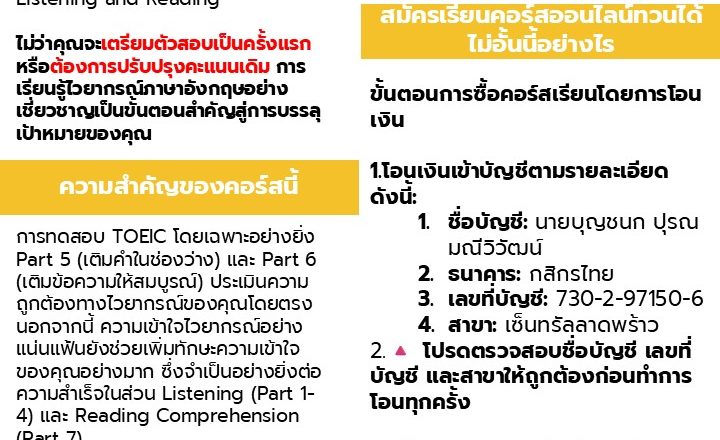
ไม่ว่าคุณจะเตรียมตัวสอบเป็นครั้งแรกหรือต้องการปรับปรุงคะแนนเดิม การเรียนรู้ไวยากรณ์ภาษาอังกฤษอย่างเชี่ยวชาญเป็นขั้นตอนสำคัญสู่การบรรลุเป้าหมายของคุณ
หลักสูตรนี้เป็นไปตามลำดับตรรกะ โดยเริ่มต้นจากส่วนประกอบพื้นฐานของประโยคภาษาอังกฤษและค่อยๆ ก้าวไปสู่โครงสร้างที่ซับซ้อนยิ่งขึ้น แต่ละบทเน้นที่ส่วนของไวยากรณ์ที่เฉพาะเจาะจง ให้คำอธิบายที่ชัดเจน ใช้ตัวอย่างที่มาจากบริบท TOEIC ทั่วไป (อีเมลธุรกิจ ประกาศ รายงาน บทสนทนาในที่ทำงาน) และมีแบบฝึกหัดเพื่อเสริมสร้างการเรียนรู้
ขั้นตอนการซื้อคอร์สเรียนโดยการโอนเงิน
แอดมินจะทำการตรวจสอบ และส่ง Username และ Password ให้กับท่านเพื่อใช้ในการล็อกอินเข้าเรียนคอร์สออนไลน์ของเรา
-
1
 แนะนำคอร์ส
ยินดีต้อนรับสู่หลักสูตรพื้นฐานไวยากรณ์ TOEIC! หลักสูตรนี้ออกแบบมาโดยเฉพาะสำหรับผู้เรียนที่มุ่งมั่นที่จะพิชิตความท้าทายทางไวยากรณ์ที่ปรากฏในการทดสอบ TOEIC® Listening and Reading ไม่ว่าคุณจะเตรียมตัวสอบเป็นครั้งแรกหรือต้องการปรับปรุงคะแนนเดิม การเรียนรู้ไวยากรณ์ภาษาอังกฤษอย่างเชี่ยวชาญเป็นขั้นตอนสำคัญสู่การบรรลุเป้าหมายของคุณ
-
2
Chapter 1: The Building Blocks – Parts of Speech & Sentence Structure
Chapter 1: The Building Blocks – Parts of Speech & Sentence Structure
Every language has fundamental components. In English, understanding the different roles words play (Parts of Speech) and how they combine to form sentences is the first step to mastering grammar.
-
3
Chapter 2: Mastering Verb Tenses – Present & Past
Chapter 2: Mastering Verb Tenses – Present & Past
Verbs change their form to show when an action happens. This is called tense. Using the correct tense is essential for clear communication and is frequently tested in TOEIC Part 5 and Part 6. This chapter focuses on the foundational present and past tenses.
-
4
Chapter 3: Mastering Verb Tenses – Perfect & Future
Chapter 3: Mastering Verb Tenses – Perfect & Future
Building on the present and past, the perfect tenses add layers of meaning related to completion and connection between time points. Future forms allow us to talk about upcoming events. These are also crucial for TOEIC accuracy.
-
5
Chapter 4: Nouns, Pronouns & Articles In-Depth
Chapter 4: Nouns, Pronouns & Articles In-Depth
We introduced nouns and pronouns in Chapter 1. Now, let's delve deeper into aspects crucial for TOEIC accuracy: countable vs. uncountable nouns, pronoun agreement, and the often-tricky articles (a, an, the).
-
6
Chapter 5: Adjectives and Adverbs
Chapter 5: Adjectives and Adverbs
Adjectives and adverbs add detail and precision to our sentences. Adjectives describe nouns/pronouns, while adverbs modify verbs, adjectives, or other adverbs. Using them correctly, including their comparative and superlative forms, is vital for descriptive accuracy and scoring well on TOEIC questions that test word forms.
-
7
Chapter 6: Prepositions and Conjunctions
Chapter 6: Prepositions and Conjunctions
Prepositions and conjunctions are the glue that holds sentences and ideas together. Prepositions show relationships between words (often location, time, or direction), while conjunctions connect words, phrases, or clauses. Mastering them is essential for both constructing sentences and understanding complex texts in the TOEIC.
-
8
Chapter 7: Modals and Conditionals (Zero & First)
Chapter 7: Modals and Conditionals (Zero & First)
Modal verbs (also called modal auxiliaries) add shades of meaning to main verbs, expressing ideas like ability, possibility, necessity, or permission. Conditional sentences explore the results of certain conditions, often using 'if'. This chapter focuses on common modals and the two most basic conditional types.